Hungaroring circuit
The Hungaroring was built in 1985 and amazingly it took just 8 months to construct. The first Formula 1 race took place in March 1986, and the circuit has been a permanent fixture on the F1 calendar ever since.
In 2025 the Hungarian Grand Prix celebrated its 40th anniversary at the Hungaroring. With no plans for this race to dissapear any time soon, it looks like it will be an F1 staple for years to come.
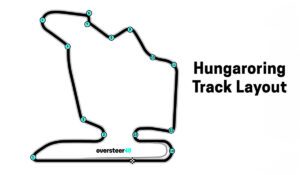
The Hungaroring has gone through a few iterations since it was first built. Below is the current layout of the track, which is 4.381km / 2.722 miles long, and has 14 corners. The track has been this layout since 2003:

1986 - 1988 Layout
When the circuit was first built it looked slightly different. It was shorter, at just 4.014 km / 2.494 miles, thanks to a shorter run to Turn 1 and a more direct Turn 11.
It also had an extra chicane at Turn 3, which wasn’t part of the original design but was included after they had to divert the track around a streak which was discovered during construction.

1989 - 2002 Layout
In 1989 the stream that had forced the design of the original track to be changed was diverted elsewhere in to a culvert, meaning the extra chicane at Turn 3 could be removed. This produced the shortest version of the Hungaroring at just 3.976 km / 2.470 miles long.
The track stayed this way from 1989 all the way up to 2002, after which Turns 1 and 11 were modified in to how they look today.

Hungarian Grand Prix DRS Zones
There are two DRS Zones at the Hungarian Grand Prix, but only one detection point, meaning a car can get a double-helping of DRS if they are within 1 second of the car ahead when they cross the detection point. That’s the case, even if the following car uses his DRS to overtake along the main straight.

- The DRS Detection Point is 50 metres before Turn 14.
- The first DRS Activation Point is 40 metres after Turn 14
- The second DRS Activation Point is 6 metres after Turn 1
Longest straight
The longest straight at the Hungaroring is the start / finish straight between Turn 14 and Turn 1. The straight is 792 metres long. That’s 0.79km / 0.49 miles long.

Hungarian Grand Prix top speeds
Each F1 circuit has a speed trap where the drivers’ speeds are measured. The Hungaroring top speeds are taken at the speed trap which is along the main straight just before the drivers hit their brakes for Turn 1.
Below is a list of top speeds clocked by the drivers during the F1 weekend
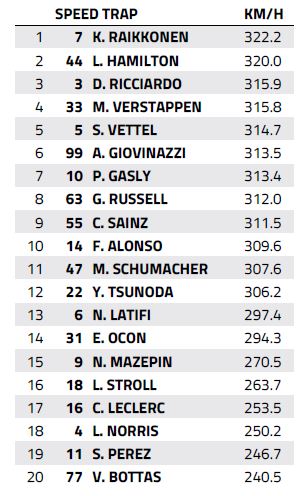
As the list shows, the highest speed achieved at the Hungaroring is 322.2kph / 200.2mph by Kimi Raikkonen driving for Alfa Romeo in 2021, his final season in F1.