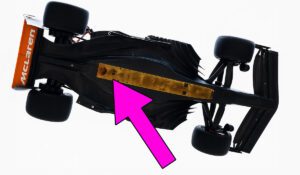
The post-Vegas GP news that both McLaren cars had been disqualified sent shockwaves through the Formula 1 paddock, not just because of the DSQ’s effect on the championship battle, but because of how extraordinarily small the infringement was.
It wasn’t a glaring rule break, nor a clever technical trick. Instead, it all came down to microscopic measurements.
The reason? Excessive wear to the skid blocks mounted under each car. In a sport where performance is measured in thousandths of a second, it was fitting that this technical breach came down to thousandths of a millimetre.
The Official Measurements
After the race, Lando Norris’ car had its Titianium Skid Blocks measured for thickness. This is standand for all cars that finish on the podium, and usually a random selection of other cars that finished the race.
Article 3.5.9 of the Technical Regulations requires all titanium skid blocks to remain at a minimum thickness of 9.00mm after the race. For clarity, it is the skid blocks themselves that are measured, not the ‘plank’.

The FIA stewards used their precision instrument, a Mitutoyo micrometre acquired in May 2025 and accurate to within 0.001mm. A micrometre is a handheld measuring device used to determine thickness or diameter with extreme accuracy, typically down to thousandths of a millimetre.
Mitutoyo, a Japanese company, is widely regarded as a global leader in precision metrology, supplying high-grade measuring equipment to aerospace, medical, scientific, and advanced engineering sectors where tolerances are incredibly tight.
The FIA’s device is believed to be from Mitutoyo’s High-Accuracy Digimatic Micrometer range, such as the QuantuMike or the IP65 Digital Micrometer series, both of which are capable of measuring down to 0.001mm (one micron). Some models—like the Mitutoyo MDC-1″MX—are specially designed with ratchet-stop systems to ensure even pressure is applied during measurement, guaranteeing consistent results regardless of the operator.
These digital micrometres are used in Formula 1 because they reduce the risk of human error and can even log measurements electronically, ensuring transparency and reliability.

Basic analogue models of Mitutoyo’s micrometres can be bought for less than $100 dollars. Digital versions cost more, but are still a relatively inexpesive tool.
They used this device to initially take the measurements on Lando’s car:
Lando Norris (Car 4):
Right-Hand Side Front: 8.88mm
Right-Hand Side Rear: 8.93mm
After seeing that his skid blocks were lower than the required minimum of 9mm, they also measured his teammate Oscar’s car (who finished off the podium):
Oscar Piastri (Car 81):
Left-Hand Side Front: 8.96mm
Right-Hand Side Front: 8.74mm
Right-Hand Side Rear: 8.90mm
In Piastri’s case, the most worn measurement was just 8.74mm—only 0.26mm below the limit. That is roughly the width of three human hairs. Norris’ most worn skid block was 8.88mm, just 0.12mm below the limit. That’s one human hair.
Formula 1 doesn’t allow for tolerance here. The rule is absolute. If a skid block measures below 9.00mm, whether by a tenth of a millimetre or a whole millimetre, the car is illegal.
Front skid blocks, not rear
What made the incident particularly intriguing was the location of the excessive wear. Throughout the 2024 and 2025 seasons, McLaren’s aerodynamic concept has been characterized by a low-running front end. Most teams manage rear skid wear, but McLaren’s strength has been in controlling front-end ride height, allowing the front skids to make more frequent ground contact without jeopardizing legality.
This is so prominent that Oscar Piastri’s cockpit seat is insulated and lined with gold foil due to heat transfer from frequent front skid scraping. In technical analysis, rivals and the FIA noted that McLaren had mastered shifting their primary floor contact forward—an uncommon but effective setup for maximizing downforce.
But in Las Vegas, it wasn’t the front—but the rear skids—that failed FIA inspection.
Why the Rear, and Why Now?
To understand why McLaren’s rear skid blocks wore more than usual in Las Vegas, we need to look at several factors.
First, Las Vegas is a unique circuit. Built on public roads, it features heavy braking zones, rapidly changing surface levels, and aggressive bumps. Combined with unusually cold night-time track temperatures, the cars struggled with bouncing (porpoising), particularly at high speeds.
Second, McLaren arrived in Vegas determined not to repeat their struggles from the previous year, where front tyre graining and temperature management had severely limited performance. To counter that, the team shifted the car’s aerodynamic balance rearward to protect the front tyres.
That change, while effective in improving qualifying and race pace, likely contributed to the rear of the car running closer to the ground under high load—especially at full fuel and during DRS-assisted high-speed runs. This increased rear compression may have caused more contact between the rear skid blocks and the track surface.
In simple terms: to solve a tyre problem, McLaren may have created a ride height problem.
No Grey Areas—Only Black and White
It’s important to note that there was no suggestion of trickery or intent. The days of adjustable or retractable skid blocks—once used by some teams to hide wear—are long gone. Since 2023, the FIA has tightened rules on how skid blocks must be fitted, ensuring they remain rigid, fully exposed, and measurable.
With the introduction of ultra-precise measuring devices like the Mitutoyo micrometre, there is no margin for ambiguity. The FIA can now detect wear differences too small for the naked eye to see. As a result, even unintentional setup decisions—causing marginally increased wear—can invalidate an otherwise legal car.